
1828-1910
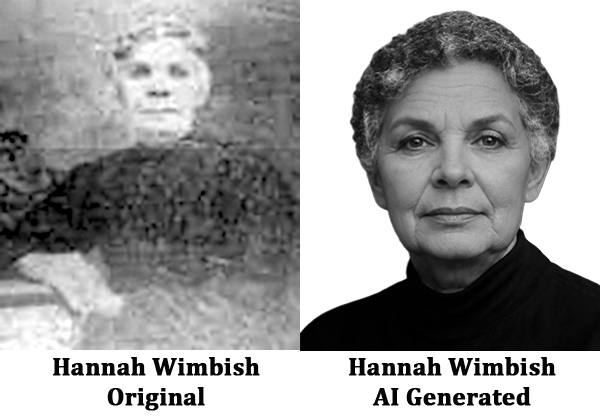
Generation 1 – Hannah & Steven Wimbish
(10 Children)
- Paul – Ettie
- Stephen – Josephine
- Selina – Ephran Taylor
- Alice – Steve Jackson
- Susan – Jim Robinson
- John – Ella
- Fannie – Thacker Sell
- Annie Roy – Roy (First name unknown)
- Elsie – Williams (First name unknown): Sandy Folk,
- Clem – Virginia
WIMBISH FAMILY HISTORY
(As reported by Tasa Wimbish on September 1, 1989)
According to Tasa Wimbish, the first known members of the Wimbish family who eventually settled in Sandy Fork, Texas were Hannah and Stephen Wimbish. Both were slaves in Virginia prior to the Emancapation Proclamation. It is not known which city in Virginia they resided. It is believed that Hannah and Stephen were owned by a slave master named “Smith” and that at one time they were known by the name of Smith also. Tasa is not sure why they eventually changed their name to Wimbish.
Hanna Wimbish, our Matriach was born in Cameron County, Virginia in 1828. She came to Texas as a slave with a “Dr. Wimbish” and his family. She was later emancipated. She married and had fifteen (15) children. Hanna died on July 10, 1910. Seven of Hanna’s children survived her: Namely – Paul Wimbish, Steve Wimbish, Johnny Wimbish, Clem Wimbish, Fanny Bryant, Alice Jackson of Cuero and Selina Taylor of Bay City, Texas. She left two sisters – Eliza Lewis and Selina Floyd. Hanna was buried in the old family cemetery near Edgar, a rural community near Cuero, Texas.
In describing Stephen and Hannah, Tasa says she remembers her parents saying that Stephen was a big man who looked like an Indian. He is described as having high cheek bones. Hannah, on the other hand, was described as being a small woman of fair complexion. It is estimated that she weighed approximately 110 pounds. It is believed that one of Hannah’s parents was of Anglo-Saxon decent. Hannah’s nickname was “Muddy”.
Shortly after the Emancapation Proclamation was issued “, ( approximately 1868) setting slaves all over the United States free, Hannah and Stephen left Virginia with several other Black families. They traveled by horse and buggy to Sandy Fork, Texas. Although they traveled much of the way by buggy, they also traveled a great deal by foot. In those times, this was the common way to travel . Making the journey with Stephen and Hannah was one of Hannah’s brothers named Sam. It is believed that a sister of Hannah’s named Liza, also traveled with this group of people. Tasa Wimbish is not sure as to how many other sisters and brothers Hannah had; however, she did recall her parents mentioning Liza and Sam.
Eventually, Hannah and Stephen arrived in Sandy Fork, Texas and decided to make it their home. Sandy Fork was about 8 miles from Cuero, Texas. At this time, Sandy Fork was a black community. There were whites living in surrounding communities, however. Hannah and Stephen purchased land in this area and built a log cabin. At this time, Blacks in this part of Texas could purchase and own land. Once their home was built, the couple pursued farming “as a means of a living”. They grew cotton, corn, peas, irish potatoes· and other such crops. They also raised cattle, sheep, pigs and goats.
Once settled in Texas, the couple decided to start their family. They had 10 children. There were 4 boys and 6 girls. There names were Paul, Stephen, Selina, Alice, Susan, John, Fannie, Annie, Elsie and Clem. Paul was the oldest · and Clem was the youngest. Shortly after all ten children were born, Stephen died leaving Hannah to raise the 10 children. She did so looking often to God for guidance. Hannah was known to be a Christian woman who took her children to church. The family church was the Mt. Zion Baptist Church in Cuero, Texas. As a member of Mt. Zion Baptist Church, Hannah was a song and prayer leader. One of the family ministers was Rev. Mitchell Harrison.
By the time Stephen died most of the couples’ children had married and moved to various parts of Texas. Hannah then lived primarily with Clem; however, she often visted her other children. Most of the Wimbish children like their parents, purchased land and became farmers. Tasa said that most of the children lived “good lives. In fact at that time, Paul :Wimbish, who lived in Pleasantville, Texas, was said by many blacks to be one of the wealthiest men in De Witt County, Texas.
Finally, on July 1910 Hannah died. She was buried in the Lockard, Texas cemetary. At her funeral, one of the church members, paying tribute to Hannah, said this about her life. “Hannah’s life says to the young man and young woman: In the days of thy youth be wise and seek thy creator. To the father and mother it says: Train the child in the way he should go and when he is old; he will not depart from it. To her sons, daughters, sisters and offsprings it says: Yield not to the allurements and temptations of this earthly life, but continue to strive to meet your dear one. To Old Mount Zion Church it says: Sail on Oh! Gospel Ship strong and great. You have landed many thousands and may you land many more. ” ( Copied as written from a document written in July 1910, that was read at Hannah’s funeral. Document was discovered by Albine Thomas.)”